

-
1 крышка выводов
крышка выводов (автоматического выключателя)
-
Принадлежности автоматического выключателя
Рис. LS Industrial Systems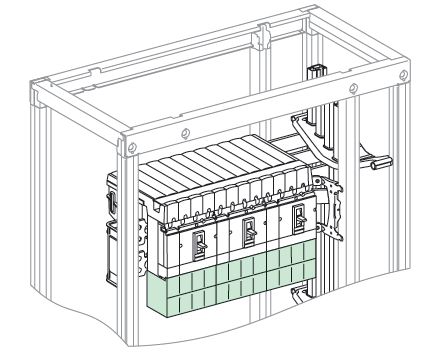
Front connection: device terminal cover
Рис. Schneider Electric Параллельные тексты EN-RUThe terminal covers are applied to the circuit-breaker to prevent accidental contact with live parts and thereby guarantee protection against direct contacts.
[LS Industrial Systems]Данными крышками закрывают выводы автоматического выключателя, что предотвращает случайное прикосновение персонала к токоведущим частям.
[Перевод Интент]Short type covers
For fixed circuit-breakers with rear terminals and for moving parts of plug-in.
[LS Industrial Systems]Короткие крышки выводов
Применяют для защиты от прикосновения к выводам стационарных автоматических выключателей для заднего присоединения проводников и втычных автоматических выключателей.
[Перевод Интент]Long type covers
For fixed circuit-breakers with front, front extended, front for cables terminals.
[LS Industrial Systems]Длинные крышки выводов
Применяют для защиты от прикосновения к выводам стационарных автоматических выключателей с передним присоединением проводников: обычных, удлиненных, для кабельных наконечников.
[Перевод Интент]Тематики
Классификация
>>>Обобщающие термины
EN
Русско-английский словарь нормативно-технической терминологии > крышка выводов
2 galleta
f.1 biscuit (British), cookie (United States) (cooking).galleta para perros dog biscuit2 slap, smack (informal) (cachete). (peninsular Spanish)dar una galleta a alguien to give somebody a slap o smack3 cookie, cracker, biscuit, cooky.4 strength, force, power, forcefulness.* * *1 COCINA biscuit, US cookie■ ¡menuda galleta se dio contra el muro! he crashed into the wall!\galleta maría Marie biscuit, rich tea biscuit* * *noun f.biscuit, cookie* * *SF1) (Culin) (=dulce) biscuit, cookie (EEUU); (Náut) ship's biscuit, hardtack; Cono Sur coarse breadgalleta de soda — And cracker
2) * (=bofetada) bash *, slap4) LAm * confusion, disordergalleta del tráfico — Ven * (=atasco) traffic jam; (=burla) practical joke
5) Cono Sur (=bronca) ticking-off *6)* * *2) (Méx fam) ( fuerza)échale galleta! — put your back into it! (colloq)
* * *2) (Méx fam) ( fuerza)échale galleta! — put your back into it! (colloq)
* * *galleta11 = biscuit, cookie.Ex: The article 'Fruit not biscuits' looks at the nature of freelance work in the field of publishing and outlines the advantages and disadvantages of working from home.
Ex: The book covers the following topics: cereals and pastas; vegetables and fruits; breads; desserts and cookies; cakes and icings; and pastry and pies.* caja de galletas = biscuit tin.* galleta con trocitos de chocolate = chocolate chip cookie.* galleta de bizcocho = sponge finger, ladyfinger.* galleta de la fortuna = fortune cookie.* galleta de la suerte = fortune cookie.* galleta escocesa de mantequilla = shortbread.galleta22 = slap.Ex: And actually a good slap is said to be statistically more likely to result in a child with agression and conduct problems, you may be interested to hear.
* dar una galleta = slap.* * *A ( Coc)2 (salada) crackerCompuestos:(CS) type of bread( Chi) sponge finger( Andes) cracker(golpe): te vas a pegar una galleta you're going to crash into somethingse me hizo una galleta con la lana the wool got tangled upE¡échale galleta! put some effort into it! o ( colloq) put your back into it!F ( Inf) cookie* * *
galleta sustantivo femenino (Coc) ( dulce) cookie (AmE), biscuit (BrE);
( salada) cracker
galleta sustantivo femenino
1 Culin biscuit, US cookie
2 fam (bofetada) slap
(golpe) bump
' galleta' also found in these entries:
Spanish:
migaja
- ninguna
- ninguno
- roer
- sola
- solo
- barquillo
- bizcocho
- empapar
- macarrón
- mojar
- pasta
English:
apiece
- biscuit
- cookie
- cracker
- crumble
- digestive biscuit
- flapjack
- fortune cookie
- gingerbread
- last
- pretzel
- will
- flap
- ginger
- rusk
- short
- wafer
* * *galleta nf1. [para comer] Br biscuit, US cookieRP galleta de campaña = type of round crusty bread;galleta salada cracker;Andes, CAm, Méx, Ven galleta de soda crackerdar una galleta a alguien to give sb a slap o smackme di una galleta en la rodilla bajando las escaleras I banged myself on the knee coming down the stairsse armó una galleta all hell broke loose8. CompArg Fam [novio] to dump sb, to jilt sb* * *f1 cookie, Brbiscuit2 Méx famstrength* * *galleta nf1) : cookie2) : cracker* * *galleta n biscuit3 Laval, Carl Gustaf Patrik de
SUBJECT AREA: Agricultural and food technology, Electricity, Mechanical, pneumatic and hydraulic engineering, Steam and internal combustion engines[br]b. 9 May 1845 Orsa, Swedend. 2 February 1913 Stockholm, Sweden[br]Swedish inventor of an advanced cream separator and a steam turbine.[br]Gustaf de Laval was educated at the Stockholm Technical Institute and Uppsala University. He proved to have an unfailing vigour and variety in his inventive talent, for his interests ranged from electric lighting and electrometallurgy to aerodynamics. In the 1890s he employed over one hundred engineers to develop his inventions, but he was best known for two: the cream separator and a steam turbine. In 1877 he invented the high-speed centrifugal cream separator, which was probably the greatest advance in butter-making up to that time. By 1880 the separators were being successfully marketed all over the world, for they were quickly adopted in larger dairies where they effected enormous savings in labour and space. He followed this with various devices for the dairy industry, including a vacuum milking machine perfected in 1913. In c. 1882, de Laval invented a turbine on the principle of Hero's engine, but he quickly turned his attention to the impulse type, which was like Branca's, with a jet of steam impinging on a set of blades around the periphery of a wheel. He applied for a British patent in 1889. The steam was expanded in a single stage from the initial to the final pressure: to secure economy with the steam issuing at high velocity, the blades also had to rotate at high velocity. An early 5 hp (3.7 kW) turbine rotated at 30,000 rpm, so reduction gearing had to be introduced. Production started in Sweden in 1893 and in other countries at about the same time. In 1892 de Laval proposed employing one of his turbines of 15 hp (11 kW) in an experimental launch, but there is no evidence that it was ever actually installed in a vessel. However, his turbines were popular for powering electric generating sets for lighting textile mills and ships, and by 1900 were available in sizes up to 300 bhp (224 kW).[br]Bibliography1889, British patent no. 7,143 (steam turbine).Further ReadingT.Althin, 1943, Life of de Laval, Stockholm (a full biography).T.I.Williams (ed.), 1969, A Biographical Dictionary of Scientists, London: A. \& C. Black (contains a brief biography).R.M.Neilson, 1902, The Steam Turbine, London: Longmans, Green \& Co. (fully covers the development of de Laval's steam turbine).H.W.Dickinson, 1938, A Short History of the Steam Engine, Cambridge University Press (contains a short account of the development of the steam turbine).R.L.Hills, 1989, Power from Steam. A History of the Stationary Steam Engine, Cambridge University Press (contains a short account).RLHBiographical history of technology > Laval, Carl Gustaf Patrik de
4 Skinner, Halcyon
[br]b. 6 March 1824 Mantua, Ohio, USAd. 28 November 1900 USA[br]American inventor of a machine for making Royal Axminster and other carpets.[br]Halcyon was the son of Joseph and Susan Skinner. When he was 8 years old, his parents moved to Stockbridge in Massachusetts, where he obtained education locally and worked on farms. In 1838 his father moved to West Farms, New York, where Halcyon helped his father make violins and guitars for seven years. He then worked as a general carpenter for eight years until he was hired in 1849 by Alexander Smith, a carpet manufacturer. Skinner designed and constructed a hand loom that could weave figured instead of striped carpets, and by 1851 Smith had one hundred of these at work. Skinner was retained by Smith for forty years as a mechanical expert and adviser.Weaving carpets by power started in the 1850s on enormous and complex machines. Axminster carpets had traditionally been produced in a similar way to those made by hand in Persia, with the tufts of woollen yarn being knotted around vertical warp threads. To mechanize this process proved very difficult, but Skinner patented a loom in 1856 to weave Axminster carpets although, it was not working successfully until 1860. Then in 1864 he developed a loom for weaving ingrain carpets, and c. 1870 he altered some imported English looms for weaving tapestry carpets to double their output.His most important invention was conceived in 1876 and patented on 16 January 1877. This was the Moquette or Royal Axminster loom, which marked yet another important step forward and enabled the use of an unlimited number of colours in carpet designs. This type of loom became known as the Spool Axminster because of the endless chain of spools carrying lengths of coloured yarns, wound in a predetermined order, from which short pieces could be cut and inserted as the tufts. It put Smith's company, Alexander Smith \& Sons, Yonkers, New York, in the lead among American carpet manufacturers. This type of loom was introduced to Britain in 1878 by Tomkinson \& Adam and spread rapidly. Skinner virtually retired in 1889 but continued to live in Yonkers.[br]Further ReadingBiography, American Machinist 23.Dictionary of American Biography, Vol. XVII.G.Robinson, 1966, Carpets, London (for the history and techniques of carpet weaving).A.Barlow, 1878, The History and Principles of Weaving by Hand and by Power, London (includes a section on pile weaving which covers some types of carpets).RLH5 Adamson, Daniel
SUBJECT AREA: Mechanical, pneumatic and hydraulic engineering, Metallurgy, Steam and internal combustion engines[br]b. 1818 Shildon, Co. Durham, Englandd. January 1890 Didsbury, Manchester, England[br]English mechanical engineer, pioneer in the use of steel for boilers, which enabled higher pressures to be introduced; pioneer in the use of triple-and quadruple-expansion mill engines.[br]Adamson was apprenticed between 1835 and 1841 to Timothy Hackworth, then Locomotive Superintendent on the Stockton \& Darlington Railway. After this he was appointed Draughtsman, then Superintendent Engineer, at that railway's locomotive works until in 1847 he became Manager of Shildon Works. In 1850 he resigned and moved to act as General Manager of Heaton Foundry, Stockport. In the following year he commenced business on his own at Newton Moor Iron Works near Manchester, where he built up his business as an iron-founder and boilermaker. By 1872 this works had become too small and he moved to a 4 acre (1.6 hectare) site at Hyde Junction, Dukinfield. There he employed 600 men making steel boilers, heavy machinery including mill engines fitted with the American Wheelock valve gear, hydraulic plant and general millwrighting. His success was based on his early recognition of the importance of using high-pressure steam and steel instead of wrought iron. In 1852 he patented his type of flanged seam for the firetubes of Lancashire boilers, which prevented these tubes cracking through expansion. In 1862 he patented the fabrication of boilers by drilling rivet holes instead of punching them and also by drilling the holes through two plates held together in their assembly positions. He had started to use steel for some boilers he made for railway locomotives in 1857, and in 1860, only four years after Bessemer's patent, he built six mill engine boilers from steel for Platt Bros, Oldham. He solved the problems of using this new material, and by his death had made c.2,800 steel boilers with pressures up to 250 psi (17.6 kg/cm2).He was a pioneer in the general introduction of steel and in 1863–4 was a partner in establishing the Yorkshire Iron and Steel Works at Penistone. This was the first works to depend entirely upon Bessemer steel for engineering purposes and was later sold at a large profit to Charles Cammell \& Co., Sheffield. When he started this works, he also patented improvements both to the Bessemer converters and to the engines which provided their blast. In 1870 he helped to turn Lincolnshire into an important ironmaking area by erecting the North Lincolnshire Ironworks. He was also a shareholder in ironworks in South Wales and Cumberland.He contributed to the development of the stationary steam engine, for as early as 1855 he built one to run with a pressure of 150 psi (10.5 kg/cm) that worked quite satisfactorily. He reheated the steam between the cylinders of compound engines and then in 1861–2 patented a triple-expansion engine, followed in 1873 by a quadruple-expansion one to further economize steam. In 1858 he developed improved machinery for testing tensile strength and compressive resistance of materials, and in the same year patents for hydraulic lifting jacks and riveting machines were obtained.He was a founding member of the Iron and Steel Institute and became its President in 1888 when it visited Manchester. The previous year he had been President of the Institution of Civil Engineers when he was presented with the Bessemer Gold Medal. He was a constant contributor at the meetings of these associations as well as those of the Institution of Mechanical Engineers. He did not live to see the opening of one of his final achievements, the Manchester Ship Canal. He was the one man who, by his indomitable energy and skill at public speaking, roused the enthusiasm of the people in Manchester for this project and he made it a really practical proposition in the face of strong opposition.[br]Principal Honours and DistinctionsPresident, Institution of Civil Engineers 1887.President, Iron and Steel Institute 1888. Institution of Civil Engineers Bessemer Gold Medal 1887.Further ReadingObituary, Engineer 69:56.Obituary, Engineering 49:66–8.Obituary, Proceedings of the Institution of Civil Engineers 100:374–8.H.W.Dickinson, 1938, A Short History of the Steam Engine, Cambridge University Press (provides an illustration of Adamson's flanged seam for boilers).R.L.Hills, 1989, Power from Steam. A History of the Stationary Steam Engine, Cambridge University Press (covers the development of the triple-expansion engine).RLHСм. также в других словарях:
Short Pump Middle School — Infobox School3 name =Short Pump Middle School established =1991 type =Public grades =6 8 head name =Principal head =Dr. Mark E. Chamberlain city =Glen Allen state =VA country =USA school colors =Red, Black, White mascot =Pumas free label… … Wikipedia
Short Cool Ones — Infobox Album | Name = The Lobbyist Type = Album Artist = Diesel Released = March 1996 Recorded = 1996 Genre = Blues Length = ? Label = EMI Producer = Doug Roberts, Chris Wilson and Diesel Reviews = Last album = Solid State Rhyme (1994) This… … Wikipedia
Jaguar E-Type — Infobox Automobile name = Jaguar E Type aka = Jaguar XK E manufacturer = Jaguar Cars parent company = British Leyland production = 1961 ndash;1975 class = Sports car predecessor = Jaguar XK150 related = Jaguar D Type Jaguar XJ13 successor =… … Wikipedia
P-type ATPase — Calcium ATPase, E2 Pi state Identifiers Symbol E1 E2 ATPase Pfam … Wikipedia
Volkswagen Type 2 (T3) — The T3 generation of the Volkswagen Type 2, also known as the Vanagon in the U.S., as the Transporter or Caravelle in Europe, and also to some in Britain and Ireland as the T25, was built from 1980 until 1991. It was the last of the rear engined… … Wikipedia
Naked short selling — Schematic representation of naked short selling in two steps. The short seller sells shares without owning them. He then purchases and delivers the shares for a different market price. If the short seller cannot afford the shares in the second… … Wikipedia
Too Short — Infobox Musical artist Name = Too Short Img capt = Background = solo singer Birth name = Todd Anthony Shaw Alias = Short Dawg, Shorty the Pimp, Too Short Baby, The One and Only, Playboy Short Born = birth date and age|1966|4|28 small|Oakland,… … Wikipedia
A Short Album About Murder — Infobox Album | Name = A Short Album About Murder Type = Album Artist = Styrofoam Caption = CD Artwork Released = flagicon|Germany 2000 Recorded = ??? Genre = Indie / Electronica Length = ??? Label = Morr Music Producer = ??? Reviews = Last album … Wikipedia
Burgess shale type fauna — A number of assemblages bear fossil assemblages similar in character to that of the Burgess shale. While many are also preserved in a similar fashion to the Burgess shale, the term Burgess shale type fauna covers assemblages based on taxonomic… … Wikipedia
N-Space (short story collection) — This article is about the short story collection. For other uses, see n dimensional space and n Space. N Space … Wikipedia
Incunabula Short Title Catalogue — The Incunabula Short Title Catalogue (ISTC) is an electronic bibliographic database maintained by the British Library which seeks to catalogue all known incunabula. The database lists books by individual editions, recording standard bibliographic … Wikipedia
Перевод: со всех языков на английский
с английского на все языки- С английского на:
- Все языки
- Со всех языков на:
- Все языки
- Английский
- Русский
Short type covers

18+
© Академик, 2000-2026
- Обратная связь: Техподдержка, Реклама на сайте
Экспорт словарей на сайты, сделанные на PHP, Joomla, Drupal, WordPress, MODx.